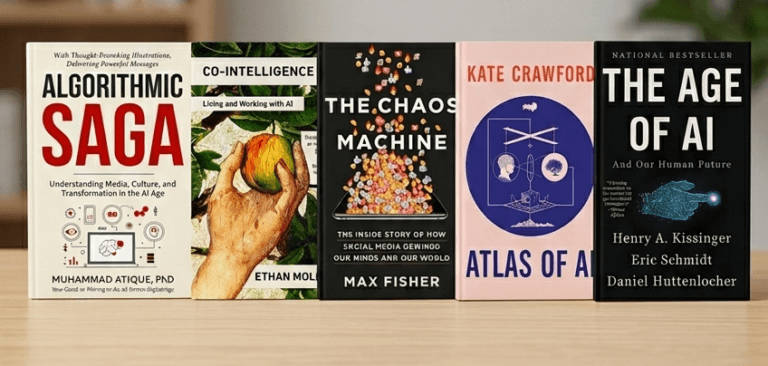
Artificial intelligence has rapidly moved from research laboratories into our everyday lives. It influences what we read, watch, buy, believe, and even how we communicate. As AI systems become embedded in media, education, business, government, and creative industries, the need for thoughtful books that explain these changes has never been greater.
Over the past few years, I have read many books exploring artificial intelligence from different perspectives. Some focus on the technical foundations, while others examine ethics, society, and the future of humanity. Below are five books that offer valuable insights into AI, media, and culture. Together, they provide readers with a broader understanding of one of the defining transformations of our time.
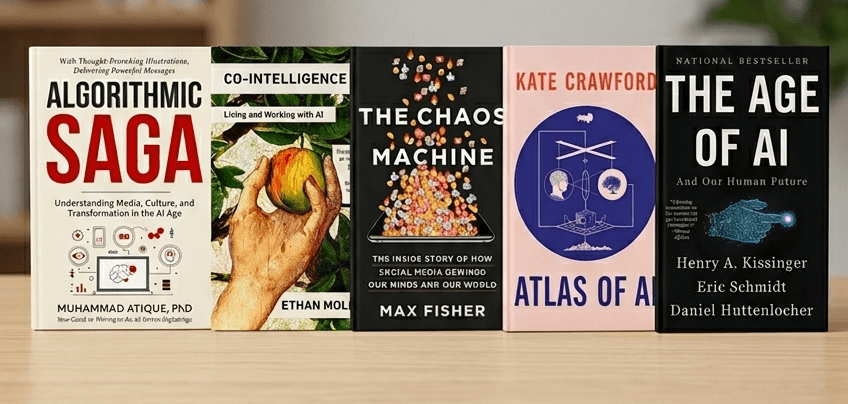
1. The Age of AI: And Our Human Future
By Henry A. Kissinger, Eric Schmidt, and Daniel Huttenlocher
This book stands out because it approaches artificial intelligence from a strategic and philosophical perspective rather than a purely technical one. The authors examine how AI is changing science, security, diplomacy, governance, and education while raising important questions about human decision-making and responsibility.
One of the book’s greatest strengths is its ability to explain why AI represents more than another technological innovation. Instead, it argues that humanity is entering a new era in which intelligent machines will increasingly influence how societies function.
While the book provides fewer practical examples from media and digital communication, it offers an excellent foundation for readers seeking to understand AI’s broader impact on civilization.
Recommended for: Policymakers, researchers, educators, and business leaders.
2. Atlas of AI
By Kate Crawford
Kate Crawford explores the hidden infrastructure behind artificial intelligence. Rather than presenting AI as an abstract technology, she examines the environmental, political, economic, and social systems that make AI possible.
The book challenges readers to think beyond algorithms by discussing data collection, labor, surveillance, natural resources, and global power structures. Crawford demonstrates that AI reflects human values, institutional priorities, and economic interests.
Although the book is more analytical than introductory, it provides an important reminder that artificial intelligence is never socially neutral.
Recommended for: Researchers, social scientists, journalists, and anyone interested in AI ethics and governance.
3. The Chaos Machine
By Max Fisher
For readers interested in social media and digital culture, this is one of the most engaging books available.
Max Fisher investigates how recommendation algorithms developed by major social media platforms have transformed online communication, political discourse, and public trust. Using extensive reporting and interviews, he explains how platform design can unintentionally amplify misinformation, polarization, and emotional engagement.
The book does not argue against technology itself. Instead, it encourages readers to examine how platform incentives shape online behavior and influence democratic societies.
Its journalistic style makes complex issues accessible without oversimplifying them.
Recommended for: Journalists, media professionals, communication scholars, educators, and general readers.
4. Co-Intelligence: Living and Working with AI
By Ethan Mollick
While many books focus on the risks of AI, Ethan Mollick offers a practical perspective on how individuals can work alongside intelligent systems.
Drawing from real classroom experiences, business applications, and everyday examples, Mollick explains how generative AI can become a collaborative partner rather than merely an automation tool. He discusses prompting, creativity, productivity, education, and workplace transformation while encouraging readers to experiment thoughtfully with AI technologies.
The book is optimistic without ignoring the challenges of accuracy, ethics, and responsible use.
For professionals seeking practical guidance rather than theoretical discussions, this is one of the strongest recent publications on generative AI.
Recommended for: Teachers, students, professionals, entrepreneurs, and organizational leaders.
5. Algorithmic Saga: Understanding Media, Culture, and Transformation in the AI Age
By Dr. Muhammad Atique
Algorithmic Saga approaches artificial intelligence through the interconnected lenses of media, communication, culture, education, governance, and digital transformation. Rather than treating AI as purely a technological subject, the book examines how intelligent systems are influencing everyday life and reshaping the institutions that organize modern society.
The book discusses topics including algorithmic influence, digital journalism, AI-driven communication, misinformation, digital literacy, platform culture, ethical decision-making, governance, and the evolving relationship between humans and intelligent technologies. It combines academic research with practical examples and aims to present complex ideas in a way that is accessible to both specialists and general readers.
One of the book’s distinguishing features is its interdisciplinary perspective. Instead of examining AI from a single discipline, it connects insights from media studies, communication, public administration, technology, and cultural studies. This integrated approach reflects the reality that AI affects multiple aspects of society simultaneously.
Readers looking for a broad overview of AI’s impact on media and culture will find it a useful introduction to the social dimensions of technological change. The book is particularly suited to university students, educators, policymakers, journalists, technology professionals, and readers interested in understanding the wider implications of AI beyond software and engineering.
Recommended for: Students, academics, policymakers, media professionals, technology enthusiasts, and anyone seeking an accessible introduction to the intersection of AI, media, and culture.
Final Thoughts
No single book can fully explain the rapidly evolving relationship between artificial intelligence and society. Each of these five books contributes a different perspective.
The Age of AI explores strategic and philosophical questions. Atlas of AI uncovers the political and economic foundations of intelligent systems. The Chaos Machine explains how algorithms influence media and public discourse. Co-Intelligence demonstrates practical ways to collaborate with AI in everyday work. Finally, Algorithmic Saga brings these conversations together by examining how AI is reshaping media, communication, culture, education, governance, and digital transformation through an interdisciplinary lens.
For readers who want to move beyond headlines and develop a deeper understanding of artificial intelligence, these books provide an excellent starting point. Together, they encourage informed discussion about one of the most significant technological and cultural shifts of the twenty-first century.